1
THE DISH

Pasta e Ceci — pasta with chickpeas — is one of the oldest dishes in Southern Italy. In Naples it's called pasta e ceci; in Rome, pasta e ceci alla romana. Both trace back to cucina povera, the cuisine of the poor, which is another way of saying: the cuisine of people who understood how to make cheap ingredients extraordinary.

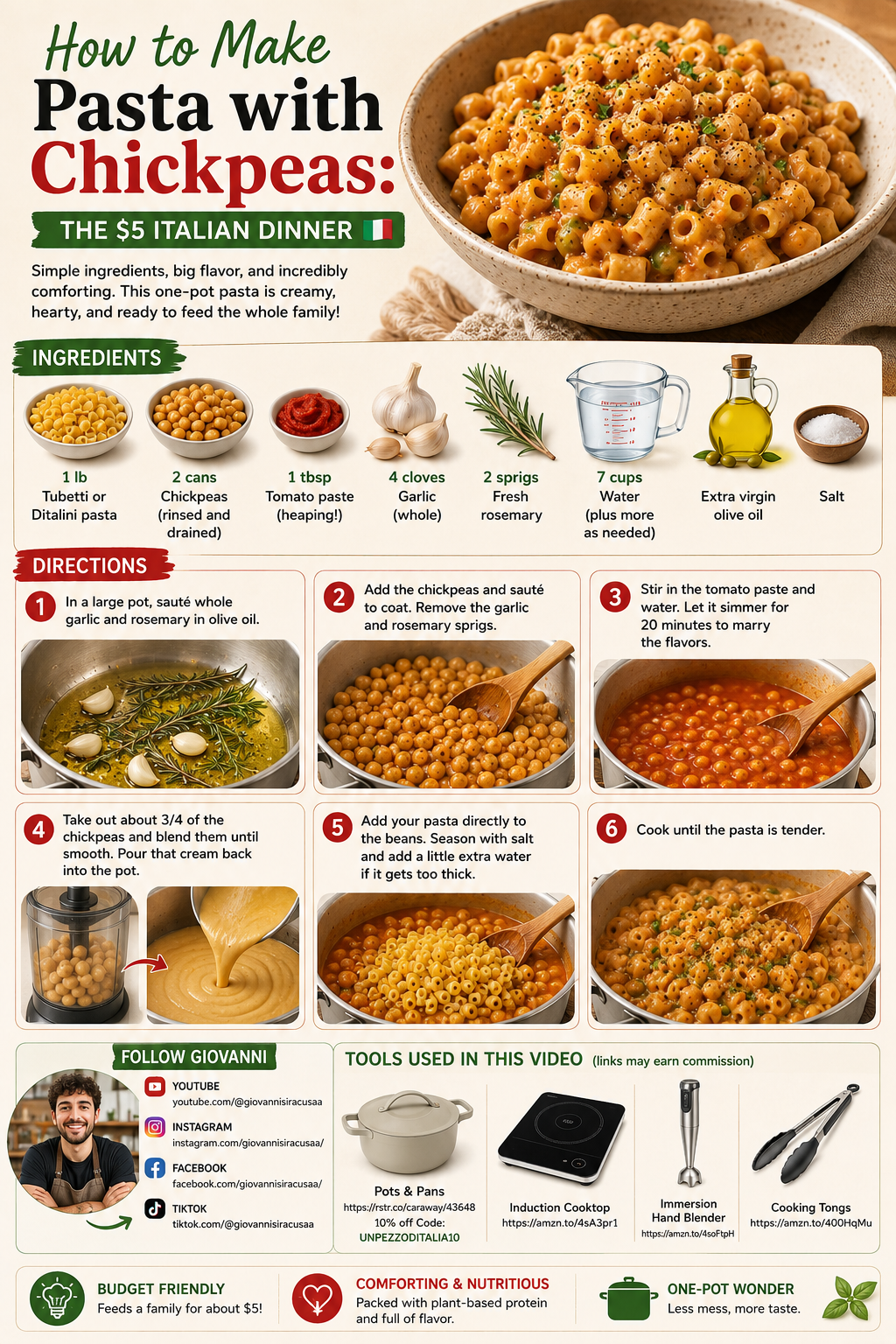
The technique that makes this dish remarkable is the same trick as Pasta e Piselli: you blend a portion of the chickpeas into a thick cream, returning it to the pot to coat the pasta. The result is a dish with the richness of something far more complex — built entirely from pantry staples, olive oil, garlic, rosemary, and time.
2
INGREDIENTS — AND WHY EACH ONE MATTERS
1 lb
Ditalini or Tubetti pasta
Short pasta traps the thick chickpea cream
2 cans
Chickpeas, rinsed
Resistant starch, fiber, plant protein, polyphenols
1 tbsp
Tomato paste (heaping)
Lycopene — fat-soluble, bioavailable with olive oil
4 cloves
Garlic, whole
Allicin, organosulfur compounds, anti-inflammatory
2 sprigs
Fresh rosemary
Rosmarinic acid, carnosic acid — potent antioxidants
Generous
Extra virgin olive oil
Oleic acid → OEA; oleocanthal anti-inflammatory
3
THE RECIPE — CAMPANIAN METHOD
  1. 1
    Heat a generous pour of extra virgin olive oil in a large pot over medium heat. Add the whole garlic cloves and fresh rosemary sprigs. Let them sizzle gently for 2–3 minutes until fragrant — you are infusing the oil with fat-soluble aromatic compounds. Do not let the garlic brown.
  2. 2
    Add the rinsed chickpeas and stir to coat them in the aromatic oil. Remove and discard the garlic cloves and rosemary sprigs — they have done their work. The flavor is now in the chickpeas and the oil.
  3. 3
    Stir in the heaping tablespoon of tomato paste until it coats the chickpeas. Pour in 7 cups of water. Bring to a simmer and cook for 20 minutes to let the flavors marry. Season generously with salt.
  4. 4
    Remove about three-quarters of the chickpeas and blend them with a ladle of the cooking liquid until completely smooth. Pour this cream back into the pot — this is what creates the thick, velvety texture without any dairy.
  5. 5
    Add the pasta directly to the pot. Cook over medium heat, stirring often, until the pasta is tender — about 10–12 minutes. Add extra water as needed to keep the consistency loose and creamy.
  6. 6
    Serve in deep bowls. Finish with a generous drizzle of your best extra virgin olive oil and a twist of black pepper. Optional: a pinch of dried chili flakes, a few fresh rosemary leaves, or a spoonful of grated Pecorino Romano.
4
THE SCIENCE — WHAT'S IN THIS BOWL
Chickpeas: The Resistant Starch Engine
Chickpeas are one of the richest sources of resistant starch in the human diet. Unlike regular starch, resistant starch passes through the small intestine undigested and reaches the colon, where gut bacteria ferment it into short-chain fatty acids (SCFAs) — particularly butyrate, propionate, and acetate. Butyrate is the primary fuel for colonocytes (colon cells), supports the intestinal barrier, and has potent anti-inflammatory effects. Propionate signals satiety via gut-brain hormones. This is why legumes have such a consistent association with metabolic health — the mechanism is lipid-mediated at the colonic level.
ChickpeasResistant starch
ColonBacterial fermentation
SCFAsButyrate, propionate
EffectsGut health + satiety
Lycopene + Olive Oil: A Fat-Soluble Partnership
Tomato paste is the most concentrated source of lycopene in the Mediterranean diet — a carotenoid with potent antioxidant properties and emerging evidence for cardiovascular and prostate cancer protection. Lycopene is fat-soluble: it requires dietary fat for absorption. The olive oil in this recipe isn't just flavor — it dramatically increases lycopene bioavailability from the tomato paste. Cooking tomato with fat in olive oil is not an accident of Italian cooking. It is a molecularly optimized delivery system, refined over centuries of empirical observation.
Rosemary: Carnosic Acid and the Brain
Rosemary contains carnosic acid and rosmarinic acid — diterpene and phenolic compounds with strong antioxidant and anti-inflammatory activity. Carnosic acid is lipophilic (fat-soluble), meaning it can cross the blood-brain barrier. Animal studies suggest it may activate Nrf2, a key regulator of the cellular antioxidant response in neurons. In this dish, rosemary is cooked in oil — again, fat is the delivery vehicle for fat-soluble bioactives.
5
WHY IT WORKS — THE NUTRITIONAL ARCHITECTURE
🫘 Complete protein from plants
Chickpeas + pasta together provide a more complete amino acid profile than either alone. This is the intuitive wisdom of pasta e legumi: legumes compensate for the amino acids limiting in grains, and vice versa.
🫒 Fat activates the bioactives
Lycopene from tomato, carnosic acid from rosemary, and OEA from olive oil itself are all fat-soluble. The olive oil is not just flavor — it is the absorption vehicle for every fat-soluble bioactive in the dish.
🌿 Prebiotic fiber diversity
Chickpeas provide resistant starch and oligosaccharides; garlic provides inulin-type fructans. This combination feeds a diverse range of gut bacterial populations — a key driver of microbiome richness.
💰 Maximum nutrition, minimum cost
This dish feeds a family of four for roughly $5. The nutritional density — protein, complex carbohydrates, fiber, antioxidants, healthy fats — per dollar spent is exceptional. Cucina povera was poor in money, not in nutrients.
6
TIPS FROM CAMPANIA
  • 🧄 Use whole garlic cloves, not minced. Whole cloves infuse the oil more gently and are removed before the chickpeas go in — you want the garlic flavor without garlic texture in the final dish.
  • 🌿 Fresh rosemary is worth it. Dried rosemary releases differently and can become bitter. Two fresh sprigs, removed after infusing, is the authentic approach.
  • 🍅 Heaping tablespoon of tomato paste. It should be enough to visibly coat the chickpeas and turn the water a deep orange-red. Don't be shy.
  • 🫒 Finish generously with raw olive oil. The finishing oil is different from the cooking oil — it delivers polyphenols that survive better at lower temperature. Use your best bottle here.
  • 💧 Keep it all'onda — loose and wavy. Like all pasta e legumi, this dish thickens dramatically as it sits. Serve it looser than you think you should.
7
THE BOTTOM LINE

Pasta e Ceci is proof that nutritional sophistication doesn't require expensive ingredients or complicated technique. Resistant starch feeding your gut bacteria. Lycopene made bioavailable by olive oil. Carnosic acid crossing the blood-brain barrier. Plant protein completing itself through grain. All of this happens in one pot, in under 30 minutes, for five dollars. The Southern Italian grandmothers who made this dish every Friday didn't need the science. The science eventually found them.

Giuseppe Astarita, Ph.D.

Translational scientist specializing in lipid biology, metabolomics, and multi-omics biomarker research. Grew up in Campania, Southern Italy. 90+ peer-reviewed publications, h-index 54, 16 patents.