1
THE DISH

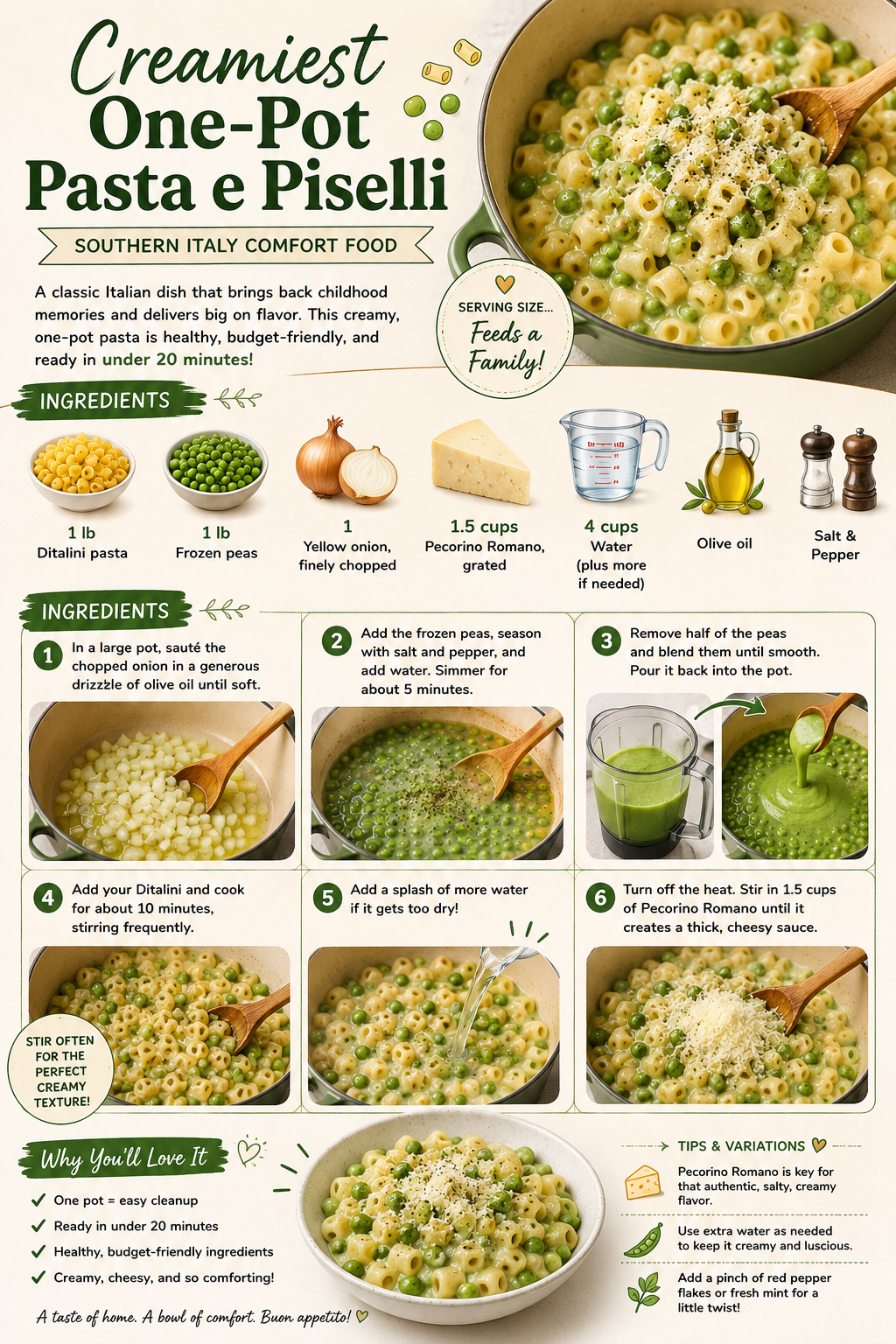
Pasta e Piselli is one of those dishes that every Neapolitan child grows up eating. It is not fancy. It requires almost nothing. And it is, by any honest measure, one of the most comforting things you can put in a bowl.

The version from Campania — my version — uses ditalini, frozen peas, olive oil, onion, and Pecorino Romano. The trick that makes it extraordinary is blending half the peas into a thick green cream that coats every piece of pasta. One pot. Twenty minutes. Science in every ingredient.
2
INGREDIENTS — AND WHY EACH ONE MATTERS
1 lb
Ditalini pasta
Complex carb + starch matrix that thickens the broth
1 lb
Frozen peas
Resistant starch, fiber, plant protein, lutein
1
Yellow onion, finely chopped
Quercetin, inulin prebiotic fiber
1.5 cups
Pecorino Romano, grated
Odd-chain fatty acids (C15:0), calcium, conjugated linoleic acid
4 cups
Water
Becomes the starchy, flavored cooking broth
Generous drizzle
Extra virgin olive oil
Oleic acid → OEA → PPAR-α satiety signal
3
THE RECIPE — 6 STEPS, ONE POT, 20 MINUTES
  1. 1
    In a large pot, heat a generous drizzle of extra virgin olive oil over medium heat. Add the finely chopped onion and sauté until soft and translucent, about 5–7 minutes. Don't rush this — a well-cooked onion is the flavor foundation.
  2. 2
    Add the frozen peas. Season with salt and black pepper. Pour in 4 cups of water. Bring to a simmer and cook for about 5 minutes until the peas are tender.
  3. 3
    Remove about half the peas with a ladle and blend them until completely smooth — either in a blender or with an immersion blender. Pour the green cream back into the pot. This is what makes it creamy without any cream.
  4. 4
    Add the ditalini directly to the pot. Cook over medium heat, stirring frequently, for about 10 minutes. The pasta will absorb the liquid and release starch, thickening everything naturally. Add a splash of water if it gets too thick.
  5. 5
    Turn off the heat. This step matters — adding cheese to boiling pasta breaks the proteins and makes it grainy. Off the heat, stir in the grated Pecorino Romano until it melts into a thick, glossy, salty sauce that coats every piece of pasta.
  6. 6
    Serve immediately in shallow bowls. Finish with a drizzle of your best extra virgin olive oil, a twist of black pepper, and extra Pecorino if you like. Eat it while it's hot — it thickens as it sits.
4
THE SCIENCE — WHAT'S ACTUALLY HAPPENING IN THAT BOWL
Oleic Acid → OEA → PPAR-α → Satiety
The olive oil in this dish is doing something precise and measurable. Oleic acid — the dominant fatty acid in extra virgin olive oil — is detected by cells in your small intestine. They respond by producing oleoylethanolamide (OEA), a lipid mediator that activates the nuclear receptor PPAR-α. This triggers two effects: the vagus nerve carries a satiety signal to the brain, and fat oxidation genes switch on in intestinal cells. One drizzle of olive oil. One molecular cascade. One reason you don't need a second bowl.
TriggerOlive oil oleic acid
SignalOEA produced in gut
ReceptorPPAR-α activated
EffectSatiety + fat oxidation
Peas: Resistant Starch + Lutein
Frozen peas contain a fraction of resistant starch — a carbohydrate that escapes digestion in the small intestine and reaches the colon, where gut bacteria ferment it into short-chain fatty acids (SCFAs) including butyrate. Butyrate is the primary energy source for colon cells and has anti-inflammatory effects. Peas also provide lutein, a carotenoid lipid that accumulates in the macula of the eye and in the brain, where emerging research links it to cognitive protection.
Pecorino Romano: C15:0 and CLA
Sheep's milk Pecorino Romano contains odd-chain saturated fatty acids — particularly pentadecanoic acid (C15:0) — that are emerging as markers of metabolic health. It also contains conjugated linoleic acid (CLA), a naturally occurring trans fat (the good kind) associated with favorable effects on body composition. Not all saturated fat is equal — the fatty acid profile of aged sheep's milk cheese is quite different from that of processed dairy.
5
WHY IT WORKS — THE NUTRITIONAL ARCHITECTURE
🫛 Satiety without heaviness
The combination of OEA from olive oil, protein from peas and Pecorino, and resistant starch creates multiple satiety signals simultaneously — hormonal, neural, and mechanical. You feel full without feeling heavy.
🫒 Anti-inflammatory fat profile
Extra virgin olive oil provides oleic acid and polyphenols (oleocanthal, oleuropein) with documented anti-inflammatory effects. The overall fat profile is strongly Mediterranean — high MUFA, low saturated fat from the cooking fat itself.
🌿 Gut microbiome support
Resistant starch from peas and onion inulin provide two different types of prebiotic fiber, feeding different bacterial populations. The combination supports microbiome diversity — a key marker of gut and metabolic health.
🧀 Protein completeness
Peas provide plant protein with a reasonable amino acid profile, complemented by the complete protein in Pecorino Romano. The combination approaches the amino acid completeness of a mixed protein source at a fraction of the cost.
6
TIPS FROM CAMPANIA
  • 🫒 Use your best extra virgin olive oil twice — once for cooking the onion, once as a finishing drizzle. The polyphenols in EVOO are heat-sensitive; the finishing oil delivers them intact.
  • 🧀 Pecorino Romano, not Parmigiano. The sharpness and salt of Pecorino is essential to Campanian flavor. Parmigiano makes a milder dish — fine, but not this dish.
  • 🌡️ Off the heat before the cheese. Always. This is the difference between a glossy sauce and a grainy mess.
  • 💧 Keep it loose. Pasta e Piselli should be all'onda — "wavy," almost soupy. Add water freely. It thickens as it sits, so err on the side of looser when serving.
  • 🌶️ A pinch of red pepper flakes with the onion is the Neapolitan variation. Not traditional everywhere, but it adds warmth without heat.
7
THE BOTTOM LINE

Pasta e Piselli is a dish that Neapolitan families have made for generations not because they knew about OEA or PPAR-α or resistant starch — but because they knew what tasted good, kept you full, and cost almost nothing. The science caught up to the wisdom. One pot. Six ingredients. Twenty minutes. A molecular argument for the Mediterranean diet in every bowl. Buon appetito.

Giuseppe Astarita, Ph.D.

Translational scientist specializing in lipid biology, metabolomics, and multi-omics biomarker research. Grew up in Campania, Southern Italy. 90+ peer-reviewed publications, h-index 54, 16 patents.